


6. Oktober 2021
Government organisations around the world are adopting artificial intelligence (AI) technologies to help them achieve their public purpose or mission, but government employees are still concerned about the technology’s impact, according Gartner, Inc.
Thirty-six percent of government respondents in the 2021 Gartner CIO survey indicated that they planned to increase investment in AI/machine learning in 2021.
Chatbots or conversational agents are leading the way in government AI technology adoption, with 26% of survey respondents reporting they have already deployed them. A further 59% expect to have deployed them within the next three years, according to the Gartner Digital Transformation Divergence Across Government Sectors survey.
However, a separate Gartner survey found that AI technologies are still viewed with a level of uncertainty, especially among the government employees who have not worked with any AI-backed solutions. More than half (53%) of government employees who have worked with AI technologies believe they provide insights to do their job better, compared to 34% of employees who have not used AI.
“Automation, insight and intelligence are all interconnected priorities for government leaders,” said Dean Lacheca, senior research director at Gartner. “But the operational and services delivery workforce are absolutely critical to the success of any attempts to automate or augment their ways of working. Leaders can generate more acceptance by clearly linking the technology to practical outcomes that benefit government employees and support mission objectives.”
While chatbots and conversational agents are currently the most widely adopted, the most significant AI technology for governments in terms of planned adoption is machine-learning-supported data mining. Sixteen percent have currently deployed it and a further 69% plan to within the next three years (see Figure 1).
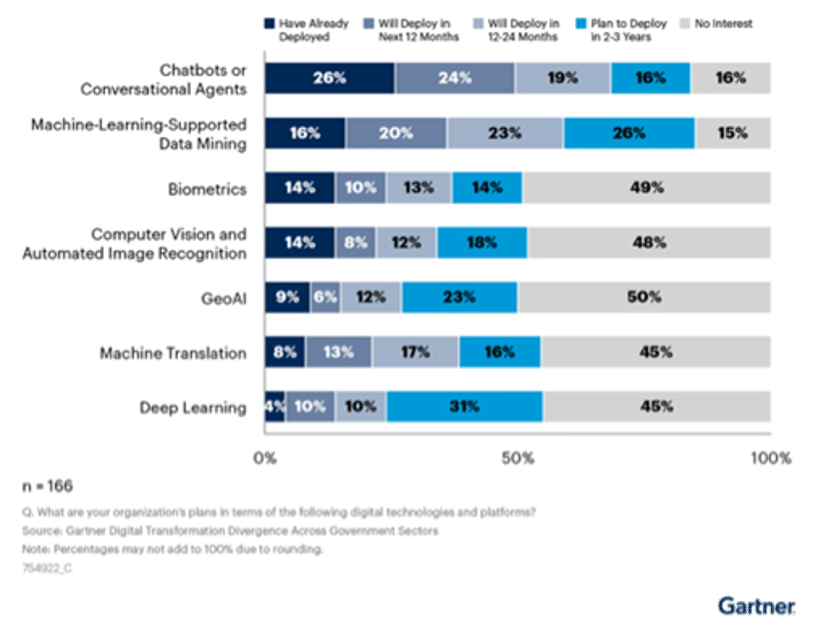
Beyond the two leading AI technologies, government organizations also plan to implement more specialised AI solutions, such as geospatial AI (GeoAI) which uses AI methods to produce knowledge through the analysis of spatial data and imagery. The lower uptake reflects the fact that it is more relevant to sub-sectors of government such as defence and intelligence, transportation, and local government.
Public sector workforce remains uncertain about AI
Forty-two per cent of government employees surveyed who have not worked with AI solutions understand that AI is a means to getting work done. But only 27% of these same respondents believe AI has the potential to replace many tasks, worsening to only 17% when it comes to what they consider to be skilled tasks. Perception improves among those employees that have worked with AI solutions.
A higher proportion of those who have used AI (31%) believe it is a threat to their jobs, compared to 24% of those who have not worked with AI. However, 44% of those who have used AI believe it improves decision making. Thirty-one per cent said AI reduces the risk of making a mistake, but 11% thought it made more errors than humans do.
“Senior executives in the public sector must address the early apprehension among the government workforce by showing how the technology helps them to getting their work done. Then continue to build confidence in the technology through exposure, use cases and case studies,” Lacheca said.
Gartner clients can learn more in the reports “Survey Analysis: Government Workforce Remain Apprehensive About AI and Automation” and “Government Insight: Align Artificial Intelligence Product Roadmap to Meet Changing Priorities.”

Fachartikel

RC4-Deaktivierung – so müssen Sie jetzt handeln

Plattform-Engineering im Wandel: Was KI-Agenten wirklich verändern

KI-Agenten im Visier: Wie versteckte Web-Befehle autonome Systeme manipulieren

Island und AWS Security Hub: Kontrollierte KI-Nutzung und sicheres Surfen im Unternehmensumfeld

Wie das iOS-Exploit-Kit Coruna zum Werkzeug staatlicher und krimineller Akteure wurde
Studien

KI als Werkzeug für schnelle, kostengünstige Cyberangriffe

KI beschleunigt Cyberangriffe: IBM X-Force warnt vor wachsenden Schwachstellen in Unternehmen

Finanzsektor unterschätzt Cyber-Risiken: Studie offenbart strukturelle Defizite in der IT-Sicherheit

CrowdStrike Global Threat Report 2026: KI beschleunigt Cyberangriffe und weitet Angriffsflächen aus

IT-Sicherheit in Großbritannien: Hohe Vorfallsquoten, steigende Budgets – doch der Wandel stockt
Whitepaper

Cloudflare Threat Report 2026: Ransomware beginnt mit dem Login – KI und Botnetze treiben die Industrialisierung von Cyberangriffen

EBA-Folgebericht: Fortschritte bei IKT-Risikoaufsicht unter DORA – weitere Harmonisierung nötig

Böswillige KI-Nutzung erkennen und verhindern: Anthropics neuer Bedrohungsbericht mit Fallstudien

Third Party Risk Management – auch das Procurement benötigt technische Unterstützung

EU-Toolbox für IKT-Lieferkettensicherheit: Gemeinsamer Rahmen zur Risikominderung
Hamsterrad-Rebell

Incident Response Retainer – worauf sollte man achten?

KI‑basierte E‑Mail‑Angriffe: Einfach gestartet, kaum zu stoppen

NIS2: „Zum Glück gezwungen“ – mit OKR-basiertem Vorgehen zum nachhaltigen Erfolg

Cyberversicherung ohne Datenbasis? Warum CIOs und CISOs jetzt auf quantifizierbare Risikomodelle setzen müssen
